

One of my favorite personal finance blogs, Get Rich Slowly, posted today Buying Food: Grocery Shopping Tips from 1950 which includes a video (yes from the 50s) and the subsequent grocery shopping tips “we” should get from this video. When I read most grocery shopping tips I get pretty annoyed – most of these are made for families with 2.5 children. You see, I am single – I eat at home (or take my lunch to work) about 60% of the time and the other times I go out with coworkers or friends. My grocery shopping habits are much different than a household of 5.
Almost every grocery shopping how-to I’ve seen includes buy in bulk. That is about the worst money saving advice for me:
- Since I’ll be the only one eating this item – I’d be stuck eating the same thing day after day to avoid it going bad.
- I live in a small place, therefore I have limited storage place.
- I live on the 4th floor and I haul my own groceries up the stairs.
So, I decided to do a little googleage and find some grocery shopping tips for one. I’ll tell ya it definitely took some digging, the first few resources I found were almost as annoying as the buy in bulk idea. In my searching I also found The Little Black Apron: A Single Girl’s Guide to Cooking with Style and Grace
Here is the single girls guide to grocery shopping:
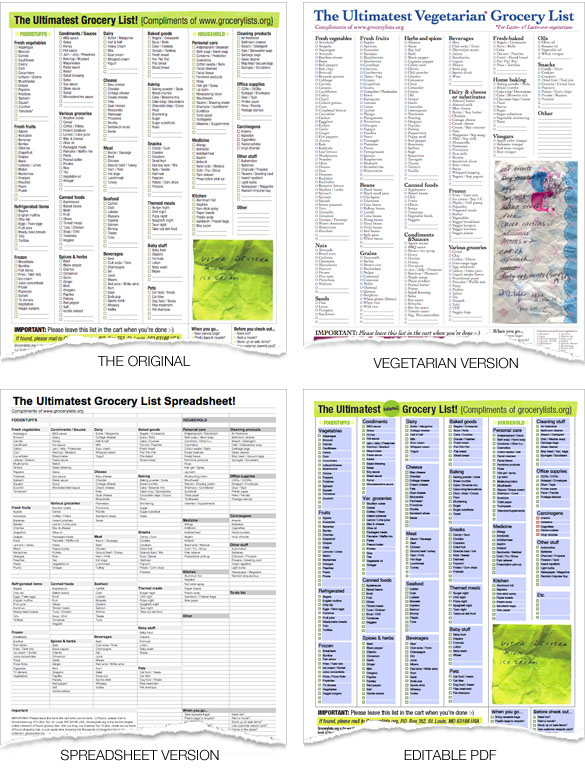
- Plan ahead: this grocery tip is universal but a definite money saver, plan your week and write your grocery list before you go to the store to avoid impulse buys. I’m personally not great at grocery lists, so my compromise is to decide how many lunches and how many dinners I will need for that week so I don’t end up with too much food. If you like paper lists The Ultimate Grocery Shopping List is a free pdf that’s a great resource (note: there is also a Vegetarian version).
- The freezer is your friend: if you think your fruit or bread may go bad before you eat it, throw it in the freezer to use later. I just learned bread only takes 1 hour to thaw. Frozen fruit is great to use in smoothies or to eat as a snack. I cut up and freeze bananas all the time to throw in cereal or smoothies. I’ve never been a fan of freezing leftover food, because I usually forget about it. But if making extra food and freezing for later works for you it’s a good money saver. (update: I just got this cookbook in Kindle format to have more freezer friendly recipes — Fix, Freeze, Feast: The Delicious, Money-Saving Way to Feed Your Family
)
- Choose the right frozen entrees: ready-made entrees can be an easy option but be sure to choose wisely so you’re not eating junk food disguised as health food. WebMD has some good frozen entree choices. An advantage I have found of frozen meals is usually they cost the same whether you buy 1 or 4, so I can try a new kind without being stuck with multiples in the event I don’t like it. These are easy take to work lunches for me (although not necessarily the most economic).
- Search high and low: the most expensive, brand-name items are typically located at eye level to make them more available to shoppers. To find the best bargains you’ll have to literally search high and low.
- Buy generic: Generic and store-brand products are often processed at the same plants as name brand products, but they are much cheaper because they aren’t advertised. A significant portion of the price you pay for a name brand product is to cover the high cost of advertising it in the various media.
- Think about your eating habits at work: avoid vending machines and bring your own snacks/drinks to work. You pay significantly less for the candy bars and drinks you buy at the grocery store than from a vending machine.
- Coupons: there are numerous sources for coupons if you’re the coupon collecting type. There are soooo many blogs that share couponing tips but I wanted to read a book to get the big picture before getting into the tactics. I read this one over the Summer, it’s less than $5 in e-book format (Pick Another Checkout Lane, Honey: Learn Coupon Strategies to Save 000s at the Grocery Store000s at the Grocery Store
)
Additional Grocery Saving Resources:
- Saving at the Supermarket: 15 Great Grocery Shopping Tips
- The Top 10 Grocery Coupon Websites for Cheapskates
- my Pinterest board: a penny saved
Do you have any grocery store suggestions to share?
It’s definitely a pain to try and save money at the grocery store when you can’t take advantage of the “economies of scale” that you get buying in bulk. It might work for some things – I like to stock up on my favorite type of pasta sauce when I can, and other non-perishables.
I love the fact that bread thaws out so fast! One thing I like to do is, if I’m making a sandwich to take somewhere, make it on frozen bread. The bread will be defrosted by the time lunch time comes around, and it keeps the sandwich just a little bit cooler!
I love the idea of making sandwiches on frozen bread so they’ll stay cool … very smart! I also buy pasta & pasta sauce when they go on sale since I’m a pasta queen and that will always do when I can’t think of anything else to eat.
Great tips. I’d never thought of the frozen bread for sandwiches, although I do use frozen bbread for toast which works well.
A few of us at work bulk cook for the week’s lunches but like you ere getting bored. So now we swap lunches with each other like school kids and get a bit more variety in our food.
Planning ahead is the best advice! My husband likes to just go to the store and buy whatever. Every time we do that, we come home with nothing to cook! Now, we each pick out two recipes and write down all the ingredients on the list. Food never goes bad, and we end up with just the right amount of left overs.
Yant, I love the idea of swapping lunches!! Great way to get rid of left overs before they go bad!
I am a very frugal lady, and I can tell you that buying in bulk DOES work. At my apartment, it’s just me and my boyfriend, so at first the thought of buying in bulk scared me. I thought everything would go bad, and the first week or two doing it, you’re spending a bit more than usual. Once you get the hang of what works best for you, it’s easy as pie. Meats are MUCH cheaper when you buy them in bulk. Chicken, for instance is usually 3 or 4 bucks per pound, but if you buy the package thats three or more pounds, it’s about a buck per pound. Set yourself up with some freezer bags, and freeze portions for yourself. Keep an eye what meats are on sale, too. Coupons are probably some of my best friends. There are often times where something will be on sale, buy one get one free, and it happens to be an item I have a coupon for. Most recently, cereal was on some silly sale. four boxes for six dollars. They also had a promotion going on that if you bought three cereals, you get a free gallon of milk. Well, I got 4 boxes, and a free gallon of milk all for six bucks. Oh wait, I lied, I had coupons too. I have a coupon for 1.50 off miniwheats. Granted, I have tons of cereal now, but it was almost free considering how much a gallon of milk costs these days.
I know a lot of coupon sites, specifically that give you rewards for redeeming, if you are interested drop me a line!
The concept of “saving money” is easier said than done for most people. I understand that it is 'easy and logical' for some people, but I also understand it can be a difficult habit to break for others.
If you're looking to save money or change your lifestyle, my advice is to take it in “baby-steps” because it won't happen overnight. Here are some tips that helped me out.
1. Always pay more than the minimum on any credit card payments – if you don't believe me you can calculate it for yourself (http://www.csgnetwork.com/creditcardmincalc.html)
2. Use coupons when grocery shopping
3. Try online shopping – it's saves on gas & they have bigger markdowns (http://www.shoptivity.com)
4. Read a book – it's cheaper than going to a movie (http://onlinebooks.library.upenn.edu/)
5. Know your budget! (https://www.dl.ed.gov/borrower/BudgetCalculator.do)
Good luck and happy savings!
Many people have never thought of this, the produce dept waters down produce to add weight to your order. So shake your lettuce a bit and see for yourself before and after on the scales right in the produce dept.
Nice post
Everyone can save money in small and seemingly insignificant areas if you know how and where to do it.
Another thing I have found when doing this same research is buying from Farmer’s Markets because there you can buy fruit in smaller quantities. Might be something to look into also. Great post!
even you can buy a single product with a lot of offers and deals at http://www.cocofortes.com
My biggest tip to anybody doing grocery shopping is to make sure that you look properly through your food storage first. Your pantry or your fridge or whatever. I can’t tell you the number of times I forgot I already had something at home and ended up with way too many of that item at the end of the day.
http://supercheapselfstorage.com.au/facilities/brisbane/north-brisbane/north-east/